Showing posts with label LOA. Show all posts

Challenges in Operationalizing Privacy in Identity Federations - Part 3

Part 1 of this series discussed the data minimization principles of anonymity, unlinkability and unobservability and their relationship to identity federation. Part 2 of this series walked through a proxy architecture that provides those principles in a federated authentication system. In this blog post, I would like to expand the discussion of the proxy architecture to include user enrollment and see how the data minimization principles are affected by the need for verified attributes.

In the proxy architecture, when a user arrives for the first time at the relying party (RP) after being authenticated by the IdP/CSP, the RP knows:

  1. A trusted IdP has authenticated the user, 
  2. The Level of Assurance (LOA) of the credential used, and 
  3. The Persistent Anonymous Identifier (PAI) associated with the credential of the authenticated user. 

Assumption: As part of the identity proofing and credential issuance process, the IdP/CSP has collected and verified information about the user (which is a requirement for LOA 2+ scenarios).

The RP starts the user enrollment process by collecting both a shared private piece of data (e.g. account #, access code, SSN etc.) that represents a claim of identity and a set of information (e.g. Name, Address, DOB etc.) that can be used to prove that claim from the user. The data elements that are collected by the RP needs to be a subset of those verified and collected by the IdP/CSP as part of the identity proofing and credential issuance process.

The RP then initiates the attribute verification process:

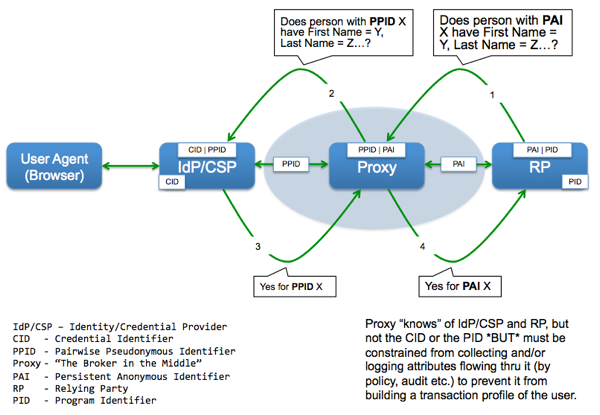
  • The request is made via the proxy to maintain the PAI to PPID mapping and the PPID to CID mapping
  • The request is for a MATCH/NOMATCH answer and NOT a "Give me all the attributes you have collected during identity proofing"
  • The shared private data (e.g. Account #, Access Code, SSN etc.), which is ALREADY in the RP system, is NOT sent to the IdP/CSP

PrivacyProxy AX

If the response that comes back from the IdP/CSP is positive, the RP:

  • Uses the shared private piece of data to pull up the associated user record 
  • Checks to see if the verified attributes returned match those in the user record
  • If they match, the RP links the PAI to the associated user record locator a.k.a. Program Identifier (PID)

Critical points to note here are that the IdP still does not know which RP the user went to, the RP still does not know which IdP the user is coming from, but the Proxy now has visibility into the attributes flowing through it.  As such, it is critical to make sure that a security policy backed by an independent audit and verification regime is put in place to assure that the proxy does not collect, store or log the attribute values flowing through it.

We would be interested to hear about how this architecture can be improved or modified to enhance its privacy characteristics.

RELATED POSTS


:- by Anil John

Challenges in Operationalizing Privacy in Identity Federations - Part 2

Federation implementations enabling privacy enhancing characteristics such as anonymity, unlinkability and unobservability are something that we are very interested in for Government service delivery. This blog post describes one such approach using a proxy mechanism between the identity provider and the relying party and articulates some of the trade-off's inherent in such an approach.

The typical identity federation scenario with an externalized Identity/Credential Provider and a Relying Party looks something like this:
Brokered AuthN

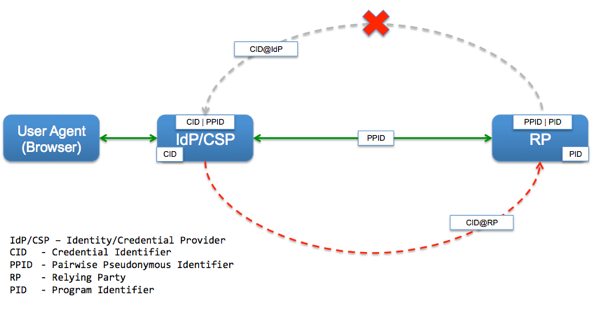
  • User's credential identifier (CID) is not released to RP. FICAM Identity Schemes require a Pairwise Pseudonymous Identifier (PPID) to limit the loss of anonymity and unlinkability; IdP keeps track of that mapping internally
  • The Program Identifier (PID) is a user record identifier that only the RP know about, and the RP establishes the one-time PPID to PID mapping via the user enrollment process
  • The IdP knows about the RP the user is interacting with so there is no mitigation for the loss of unobservability

If implementing this using SAML 2.0, this would be the classic SAML Web SSO Sequence Diagram with a persistent identifier for NameID:

Brokered AuthN SAML

One approach that would bring additional privacy enhancing characteristics into this mix is the implementation of a Proxy between the Identity Provider and the Relying Party:

Privacy Proxy

  • CID to PPID mapping is the same as before. Limits loss of anonymity and unlinkability
  • When a PPID comes into the proxy, it generates an associated Persistent Anonymous Identifier (PAI) which is then released to the RP. The proxy manages the persistent PPID to PAI mapping. 
  • Limits loss of unobservability, since IdP has no visibility into which RP the user has gone to or the identifier that they are using at that RP 
  • RP know that a trusted IdP authenticated the user and the associated LOA level but nothing more
  • RP manages the PAI to PID mapping
  • The proxy knows of the IdP and the RP but knows nothing other than the PPID and the PAI
  • Forensics requires coordination across IdP, Proxy and RP

As an aside, I would like to acknowledge our colleagues at TBS Canada for how they defined PAI and PID (PDF); I saw no value in coming up another term to describe the same items, so decided to simply leverage their definitions.

If implementing this in SAML 2.0, the sequence diagram with the proxy taking on both IdP and RP roles as needed would look like:

Privacy Proxy SAML

This architecture works brilliantly as a privacy enhanced credential mediation service and it can very easily be implemented using current technical protocols. But it does require the responsibility for identity proofing (before enrollment) to rest with the RP. So some questions that need to be explored are:

Any insights and lessons learned on working with this type of architecture would be appreciated.

RELATED POSTS

:- by Anil John

How To Collect and Deliver Attributes to a Relying Party for User Enrollment

In order for user enrollment to work at a Relying Party (RP) it needs a shared private piece of data that represents a claim of identity (e.g. SSN, Drivers License #) and a set of information that can be used to prove the claim. The manner in which the RP obtains the latter depends to a great degree on the identity verification model that is used. This blog post describes the steps and considerations regarding attribute movement for the purpose of user enrollment.

The steps in this process, from the perspective of the RP, are:

  1. Determine the minimal set of attributes (attribute bundle) needed to uniquely identify a person, map them into an existing record at the RP or create a new record if it does not exist
  2. If the attributes are Personally Identifiable Information (PII), implement the necessary protections (both policy and technology) needed to safeguard them during collection, transit, and at rest
  3. Determine who will collect, verify and bind the attributes to an identifier, and if the assurance level of that binding is acceptable
  4. Determine the secure mechanism needed to move the attributes from the entity that collected them to the Relying Party

1. Determine the minimal set of attributes

  • RP DataCollectionWhat is the minimum set of attributes needed to uniquely identify a person within a system?
  • Can we standardize this "attribute bundle" across multiple systems? e.g. Does the combination of Social Security Number, Date of Birth, State of Residence serve to uniquely identify  a person? More? Less?


2. Implement PII Protection on collected attributes 

  • Has a Privacy Impact Assessment been done that includes clear identification of the data needed and collected?
  • Do you have the authority to collect this information? How will you track and verify user consent?
  • Have you implemented technical and policy protections on PII information as required?


3. Who will collect and verify the attributes?

  • Will the attributes be collected and verified by an Identity/Credential Provider or a Registration/Identification Service?
  • Will the attributes be collected by the Relying Party and be verified directly or by leveraging a third party service?
  • Is the verification of attributes and the binding to an identity comply with NIST 800-63-1(PDF) identity proofing requirements?
  • If the verified attributes provided by the IdP/CSP/AP are not sufficient, do you need to implement the ability to request the data directly from the citizen or implement an attribute request/verification capability with a third party service? 

4. How will you securely move the attributes?
  • Back Channel RP Data CollectionHow will you move the verified attributes from an IdP/CSP/AP to the RP?
  • Will the attributes be sent every time by the IdP/CSP/AP to the RP? Is there a mechanism to provide a hint regarding first time enrollment?
  • Does support for using an out-of-band attribute call to the IdP/CSP/AP exist with all entities in the flow? If needed, what will you use as the identifier?
  • Does the ability to capture and pass consent regarding attribute release exist?


One other attribute movement mechanism that is often used by Enterprise as an IdP, is to out of band provision an RP via some sort of an Identity Bridge mechanism. That particular use case comes into play when you are connecting the Enterprise to a SaaS Provider. That use case is out of scope.

Feedback on how you are implementing these types of capabilities in your Enterprise would be appreciated. Are there additional or different approaches or considerations?

RELATED POSTS

:- by Anil John

What is new in the FICAM Trust Framework Provider Adoption Process?

The FICAM Trust Framework Provider Adoption Process (TFPAP) is the mechanism used by the Government to leverage industry-based credentials, that citizens already have, for use at Government web sites.

The current version of the Trust Framework Provider Adoption Process (PDF) was finalized in 2009. Since that time there has been great progress in E-Government activities, such as the launching of the National Strategy for Trusted Identities in Cyberspace (NSTIC) and the decision to move out on the FCCX initiative.

Input from Agencies that desire to deliver higher value Government to Citizen services combined with the increasing maturity and practical experience around credential and identity proofing offerings for higher Levels of Assurance are factors that affect this process.

To assure that the TFPAP is keeping pace with policy, technology and process advancements, we are starting the work needed to update the Trust Framework Provider Adoption Process. Some of the items we expect to address as part of this update include:

  • Bringing all externally issued credentials from LOA 1 to 4, both non-PKI and PKI (i.e. PIV-I and Medium/HW credentials), under the TFPAP so that there is a consistent policy and guidance about how Agencies can best utilize these externally issued credentials. 
  • Privacy Guidance, which was separately developed by the FICAM will be updated and integrated directly into the new TFPAP.
  • Exploring how best to bring the TFPAP to bear on the Identity Provider / Attribute Provider / Relying Party aspects individually, and together.
  • Integrating a robust and ongoing Test and Evaluation program into the TFPAP
  • More...

Ultimately we are looking to make the TFPAP a more agile process and will be working with multiple stakeholders including, and especially, our existing approved Trust Framework Providers. The goal, as always, is to assure that we meet the needs of both Citizens and Agencies that seek to leverage these externally issued credentials.

RELATED POSTS


:- by Anil John

RFI/RFP Language for Federation Solutions and Identity Proofing Solutions

As noted in my earlier blog post "Comply with Requirements Quickly and Easily with RFI and RFP Templates", FICAM is working to make it easier for Agencies to align with OMB/NIST/FICAM policies. Given below is recommended language that aligns with policy for incorporation into Agency RFIs and RPFs.  The language covers both identity federation solutions, when the Agency is acting as a relying party, as well as identity proofing solutions.

Identity Federation Solution for Agency as Relying Party

Details: A federation solution is typically integrated with an Agency web application, and needs to support both non-government issued approved credentials as well as government issued credentials. Government issued credentials in this case are Agency issued PIV Cards and approved non-government credentials such as PIV-I and those that are governed by the FICAM Trust Framework Solutions Process.

Identity Proofing Service

  • MUST have an identity proofing service capable of implementing [remote and/or in-person] identity proofing processes at [OMB-O4-04 LOA Level(s) here] per NIST SP 800-63-1

Details: NIST SP 800-63-1(PDF) is the authoritative document that provides information on the technical controls and approaches that an Agency must use for remote as well as in-person identity proofing requirements from LOA 1-4. Currently, FICAM does not have a certification process for a stand-alone identity proofing capability; current FICAM certification, via the Trust Framework Adoption Process, applies to a combined identity proofing-credential issuance solution. As such the requirements levied on an Identity Proofing service are based on the foundational requirements that all US Government Agencies must follow in complying with NIST Guidance.

Do keep in mind the following:

  • The focus above is on the technical bits-n-bytes
  • The above is just a starting point; Agencies are free to modify and add on other requirements as needed
  • The above is subject to change based on new and/or updated policies

RELATED POSTS


:- by Anil John

GSA OGP Announces an Industry Day on Federal Federated Identity Solutions

Earlier this year, the White House convened the Federal Cloud Credential Exchange (FCCX) Tiger Team comprised of several federal agencies that have a vital need to better assist the public and reduce Federal costs by moving more services online. In alignment with President Obama’s National Strategy for Trusted Identities in Cyberspace, the FCCX Tiger Team’s objective is to facilitate the Federal government’s early adoption of secure, privacy-enhancing, efficient, easy-to-use, and interoperable identity solutions.

Over the past few months, the FCCX Tiger Team has worked on the use cases and the functional requirements necessary for the operation of an identity federation capability that can be integrated with a government agency web application to support and consume a full range of digital credentials such as PIV, PIV-I, and other third party credentials issued under a FICAM-approved Trust Framework Provider.

In simple terms, the Federal government is interested in leveraging one or more commercially available cloud service providers to streamline the burden agencies face in trusting and integrating with FICAM-approved credentials.

As the next step, the FCCX Tiger Team would like to hear from industry vendors on how they might implement a privacy-enhancing, cloud-based, federated credential exchange service.

If you are a product or solutions provider that has the ability to offer these capabilities and would like to help inform the service, please submit your name and company via e-mail to icam [at] gsa [dot] gov by Wednesday, August 1, 2012 and we will provide more information about the requested written response and associated logistics.

In addition, for those who contact us, GSA Office of Governmentwide Policy (GSA OGP) will be holding an Industry Day on Tuesday, August 7th, 2012 (9am – 12:30pm EST) at GSA OCS, 1275 First Street NE, Washington DC, Room 1201B (NoMa-Gallaudet Station – DC Metro Red Line) to gather more information and answer questions from industry vendors regarding the FCCX initiative. We will be able to host both virtually and in person. In person space is limited, so let us know your preference when you contact us.

As an overview, the following topics should be addressed in your written response which will be due by 5 P.M. EDT on Monday, August 13 20, 2012:

  • Proposed high level architecture for enabling authentication to an Agency application using third party credentials to include:
    • Shared service operated in a cloud environment servicing multiple Agencies
    • Operation in an Agency-hosted environment
  • User interface approaches for selection of approved credentials
  • Credential registration and authentication strategies for citizens with multiple approved credentials
  • User enrollment approaches
  • Assurance level escalation approaches
  • Attribute request/consumption approaches
  • Supported protocols, profiles and schemas for creating and sending assertions
  • Abstracting and streamlining business relationships with FICAM approved credential providers at all levels of assurance
  • Preserving privacy (minimize storage of personal information and “panopticality” of the service)
  • Auditing
  • Scalability of the service
  • Costs models (Pay per User or application using tiered volume discounts, O&M)
  • Other relevant information

UPDATE (8/3/12): We've had a couple of questions about what is meant by "panopticality" above.

Within the context of FCCX it means two things:

  1. It is the ability of Credential Providers to "see" all the Service Providers to which a citizen authenticates
  2. It is the visibility that the FCCX service itself may have into the citizen information that is flowing thru it


:- by Deb Gallagher (GSA) & Naomi Lefkovitz (NIST) - FCCX Tiger Team Co-Chairs

New Kantara Assessment Process Provides Flexibility While Maintaining Rigor

FICAM's Trust Framework Adoption Process allows us to use comparability criteria to adopt industry trust frameworks for use by the Government. Flexibility and innovation in managing the process are critical to making sure Government requirements can take advantage of innovation in the industry. Kantara Initiative, one of our approved Trust Framework Providers (TFPs), recently updated their assessment criteria in a manner that continues to meet the requirements of FICAM and NIST, while at the same time providing flexibility in assessing solution providers.

Kantara Initiative LogoKantara's trust framework, which has been approved by FICAM, is called the Kantara Initiative Identity Assurance Framework. A critical component of it is the Service Assessment Criteria which establishes baseline criteria for general organizational conformity, identity proofing services, credential strength, and credential management services against which all FICAM Credential Service Providers are verified for assurance.

General thinking of the TFPs has been a single entity would perform all activities of a solution, but it has always been feasible under the Trust Framework Solutions process to have separate entities doing the identity proofing and credential issuance functions. Kantara has restructured their Identity Assurance Service Assessment Criteria to accommodate independent assessment of these functions, which in turn can now be offered by different providers as a component of the complete solution.

In line with how the E-Authentication model in NIST SP 800-63 provides for logical and physical separation between the Registration/Identity-Proofing function and the Token/Credential Management function, Kantara's restructured service assessment criteria performs assessments across two dimensions:

  1. Organizational Assessment, which is required of all entities undergoing assessment
  2. Operational Criteria Assessment, which covers the actual component services being offered

The flexibility in this approach comes from the fact that multiple organizations, each with its own unique service offering, can now come together to offer component services. The restructured assessment criteria now allows for these individual service components to be assessed independently. These services can be unique to each assurance level, but taken together provides a full service capability that combines both Registration/Identity-Proofing and Credential Management.

This approach provides significant opportunities for partnering between organizations, which can now put together unique and tailored solutions that, in total, satisfy the service assessment criteria. From the FICAM perspective, it is important to note that we apply the "FICAM Approved" label only to the total package made up of the various service components that together offer the complete Registration/Identity-Proofing and Credential Management functions.

National Institute of Standards and Technology (NIST) and General Services Administration (GSA) personnel welcome this new approach from Kantara, which without reducing the rigor of the assessment criteria, allows for innovative industry partnering as well as tailored and flexible service offerings to the Government.

RELATED POSTS


:- by Deb Gallagher

If You Don't Plan For User Enrollment Now, You'll Hate Federation Later

User enrollment (a.k.a. user activation, user provisioning, account mapping) into a relying party (RP) application is one of those pesky details that is often glossed over in identity federation conversations. But this piece of the last mile integration with the relying party is fundamental to making identity federation work. This blog post describes this critical step and its components.

User EnrollmentEnrollment is defined here as the process by which a link is established between the (credential) identifier of a person and the identifier used within an RP to uniquely identify the record of that person. For the rest of this blog post, I am going to use the term Program Identifier (PID) to refer to this RP record identifier [A hat tip to our Canadian colleagues].

Especially when it comes to government services, a question that needs to be asked is if the citizen has an existing relationship with the government agency. If it exists, the Gov RP should have the ability to use some shared private information as a starting point to establish the link between a citizen's (credential) identifier (obtained from the credential verifier) and the PID. e.g. Driver's License Number (DL#) if visiting the Motor Vehicle Administration (MVA) or Social Security Number if visiting the Social Security Administration.

It is important to note that this information is already known to the RP, used only as a claim of identity by the citizen, and providing just this information does not constitute proof of identity. i.e. When I provide my DL# to the MVA, I am saying that "Here is DL# XX-XXXXXXX; I claim that I am the Anil John you have on record as being the owner of that DL#". Before enrollment, the MVA would still need to verify that it is indeed me making this claim using an identity proofing process, and not an identity thief who has obtained my DL#.

So for enrollment to work, the RP needs two sets of data:

  1. A shared private piece of data that represents a claim of identity by the citizen
  2. A set of information that can be used to prove that claim to the satisfaction of the RP
If the identity verification is successful, the RP can establish a link the between credential identifier (OpenID PPID, SAML NameID, X.509 SubjectDN etc.) and the PID.

In cases where shared private information does not exist between the citizen and the agency, some options to consider are:
  1. In-person identity proofing
  2. Attestation from a trusted third-party
  3. Shared service for enrollment across multiple RPs (Privacy implications would have to be carefully worked through)
  4. No linking possible; treat as new record
Are there variations or additions to this step that I have not captured above?

RELATED POSTS

:- by Anil John

How to Verify Citizen Identity Easily and Effectively

Identity verification of citizens is critical to delivering high value government services online. Differing approaches to identity verification include front-end identification, which fits well with existing Government trust models, and back-end identification, based on widely deployed commercial practices. This blog post describes these two common models and the approach and trade-offs associated with each.

One of the reasons for trying to articulate this is that I have found myself recently in multiple settings discussing protocol flows and privacy preserving crypto.  But at the end of the discussion, I often feel as though we have not asked ourselves some foundational questions regarding choices made in identity proofing and credential issuance.  This in turn has resulted in a lack of clarity around the downstream impact of those choices on privacy, security and flexibility. So here goes...

Front End IDModel 2


The Front-End Identification is the same as the E-Authentication model that is found in NIST SP-800-63-1 (PDF). It follows the sequence of:
  1. Person Registration/Identification
  2. Binding of Identity and Token
  3. Credential Registration/Issuance
  4. Person Enrollment at Relying Party
ApproachTrade-Offs
  • Identity proofing is done up front by a credential provider with registration function or using a separate registration authority
  • Credential incorporates assurances of identity
  • User enrollment at RP based on information available from the identity proofing process and/or other sources [Enrollment is defined here as the creation of an association between the person's identifier and the index for the person within the RP application]
  • Ability to leverage results of identity proofing across multiple relying parties
  • RPs limited to approved credentials that meet assurance criteria
  • May be harder to utilize a higher LOA credential in transactions that support anonymity and pseudonymity without "beautiful math" or other proxy mechanisms
 

Back End IDModel 2


The Back-End Identification is the E-Authentication model that is found widely deployed in the commercial space. It follows the sequence of:
  1. Credential Registration/Issuance
  2. Person Registration/Identification
  3. Binding of Identity and Token at Relying Party
  4. Person Enrollment at Relying Party
ApproachTrade-Offs
  • Credential is often little more than a token (i.e. shared secret) and may have little to no assurances of identity
  • Identity proofing done directly by the RP or by using a separate proofing capability to the level required by policy
  • User enrollment at RP based on information available from the identity proofing process and/or other sources [Enrollment is defined here as the creation of an association between the person's identifier and the index for the person within the RP application]
  • Any token and/or combination of tokens can be used depending on the “technical strength” needed
  • Proofing process can be as stringent as need be, so the information in credential can be as anonymous or revealing as need be
  • Inability to leverage identity proofing across multiple RPs
 

Have I accurately captured the two major approaches in play right now? Are there trade-offs that you can think of that should be added to the lists above? 
 
UPDATED: 12/1/2012 with clarifying text and pictures re: where the token-identity binding takes place
 
RELATED POSTS

:- by Anil John

FICAM Trust Framework Solutions - A Primer

It is in the Government's best interest to not re-invent the wheel and leverage Industry resources whenever possible. To support E-Government activities, FICAM aims to leverage industry-based credentials that citizens already have for other purposes. At the same time, the Government has specific Privacy and Security requirements that need to be satisfied in order for a Government relying party to trust a credential that has been issued by an entity other than the US Federal Government.

The approach used to assess external (to the US Federal Government) credential issuance processes against these privacy and security requirements is called the FICAM Trust Framework Solutions:


As you can see in the diagram above, the entities in this mix are a Trust Framework Provider, one or more Identity Providers (IdPs), and FICAM.
  • A Trust Framework Provider (TFP) is an entity, separate from the Federal Government, that has a certain level of organizational maturity and owns/manages/has a mechanism to assess credentialing process across a range of facets that include assurance, privacy as well as auditing & certification processes using qualified independent auditors i.e. it owns and is responsible for a Trust Framework.
  • The Trust Framework Provider in turn has the capability to assess Identity Providers to see if the IdP has a certain level of organizational maturity and if its registration & identity proofing processes, credentials,  credential issuance processes and privacy policies meet the policies codified under the TFP's Trust Framework.
  • Where FICAM comes into the picture is via using our Trust Framework Adoption Process (PDF) in order to "adopt" an existing Industry Trust Framework. What that means is that we use the adoption process to see if the requirements of the Trust Framework we are using internally within the Government are comparable to the existing Industry Trust Framework. I especially want to emphasize that the intent here is comparability and NOT compliance. If they are indeed comparable, we adopt and certify that industry Trust Framework Provider, and customers of Identity Providers who have been assessed and approved by that TFP can now use those credentials at TFP-enabled Federal Government relying parties.
It is important to call out some specific points:
  • Trust Framework Providers are NOT Identity Providers
  • Trust Framework Providers assess IdPs for conformance against their Trust Framework and not the Government Trust Framework
  • The Government does not directly certify Identity Providers under the Trust Framework Solutions Process; The Government directly certifies ("adopts") Trust Framework Providers
It is critical to note that the Level of Assurance (LOA) you can have in an Identity is a big deal to the US Federal Government, and as you go to higher LOAs (from 1 to 4) the more stringent the credential issuance and identity proofing processes become.  As such, TFPs and their Trust Frameworks need to have comparable processes to the Government Trust Framework at higher LOAs in order for them to be able to assess IdPs as being able to issue higher LOA credentials.  In some cases, a TFP may make a conscious choice that they will assess only IdPs at specific LOA levels.

Let me, at this point in time, add a bit of nuance to this process. The Government E-Authentication Model provides for a logical and physical separation between the Registration/Identity-Proofing function and the Token and Credential Registration/Issuance function. In the IdP model noted above those functions are shown together. They do not have to be. It is perfectly feasible under the Trust Framework Solutions Model to have separate entities doing the Identity Proofing and the Credential Issuance, and coming together to provide a combined solution that can be certified by a TFP. Simply be aware that under the current FICAM TFP regime the term "FICAM Approved" applies to that combined solution and NOT to the individual components.

Since October 2011, there has been an OMB Policy that requires Government web sites that allow members of the public and business partners to register or log on, to be enabled to accept externally-issued credentials (i.e. credentials issued by an entity other than the US Federal Government) in accordance with government-wide requirements (PDF). The Trust Framework Solutions Process satisfies that requirement by enabling a scalable model for extending identity assurance across a broad range of citizen and business needs.

Related Information
:- by Anil John

Why LOA for Attributes Don’t Really Exist

This is a guest post on Authoritative-ness and Attributes by Dr. Peter Alterman. Peter is the Senior Advisor to the NSTIC NPO at NIST, and a thought leader who has done pioneering and award-winning work in areas ranging from IT Security and PKI to Federated Identity. You may not always agree with Peter, but he brings a perspective that is always worth considering. [NOTE: FICAM ACAG WG has not come to any sort of consensus on this topic yet] - Anil John


As I have argued in public and private, I continue to believe that the concept of assigning a Level of Assurance to an attribute is bizarre, making real-time authorization decisions even more massively burdensome than they can be, and does nothing but confuse both Users and Relying Parties.

The Laws of Attribute Validity

The simple, basic logic is this: First, an attribute issuer is authoritative for the attributes it issues. If you ask an issuer if a particular user’s asserted attribute is valid, you’ll get a Yes or No answer. If you ask that issuer what the LOA of the user’s attribute is, it will be confused – after all, the issuer issued it. The answer is binary: 1 or 0, T or F, Y or N. Second, a Relying Party is authoritative for determining what attributes it wants/needs for authorization and more importantly, it is authoritative for deciding what attribute authorities to trust. Again the answer is binary: 1 or 0, T or F, Y or N. Any attribute issuer that is not authoritative for the attribute it issues should not be trusted and any RP that has no policy on which attribute providers OR RESELLERS to trust won’t survive in civil court.

Secondary Source Cavil

“But wait,” the fans of attribute LOA say, what if you ask a secondary source if that same user’s attribute is valid. This is asking an entity that did not issue the attribute to assert its validity. In this case the RP has to decide how much it trusts the secondary source and then how much it trusts the secondary source to assert the true status of the attribute. Putting aside questions of why one would want to rely on secondary sources in the first place, implicit in this use case is the assumption that the RP has previously decided who to ask about the attribute. If the RP has decided to ask the secondary source, that is also a trust decision which one would assume would have been based on an evaluative process of some sort. After all, why would an RP choose to trust a source just a little bit? Really doesn’t make sense and complicates the trust calculation no end. Not to mention raising the eyebrows of both the CISSO and a corporate/agency lawyer, both very bad things.

Thus, the RP decides to trust the assertion of the secondary source. The response back to the RP from the secondary source is binary and the trust decision is binary. Some Federation Operator (or Trust Framework Providers, take your pick) may be serving as repositories of trusted sources for attribute assertions as a member service and in that case it, too, the RP would choose to trust the attribute sources of the FO/TFP explicitly. If a Federation Operator/TFP chooses not to trust certain secondary sources, it simply doesn’t add them to its white list. Member RPs that choose to trust the secondary attribute sources would do so based upon local determinations, underscoring the role of prior policy implementation.

Either directly or indirectly, an RP or a TFP makes a binary trust decision about which attribute providers to trust, and so the example reduces to the original law.

Transient Validity, aka Dynamic Attributes

Another circumstance where attribute LOA might be considered is querying about an attribute which changes rapidly in real time. One must accept that an attribute is either valid or invalid at the time of query. If temporality is of concern, that is a whole second attribute and a trusted timestamp must be a necessary part of the attribute validation process. A query from an online business to an end user’s bank would want to know if the user had sufficient funds to cover the transaction at the time the transaction is confirmed. At the time of the query the answer is binary, yes or no. It would also need a trusted timestamp that itself could be validated as True or False. That is, two separate attributes are required, one for content and one for time, both of which must be true for the RP to trust and therefore complete the transaction. Even for ephemeral attributes the answer is directly relevant to the state of the attribute at the time of query and that answer is binary, Y or N, the only difference being that a second trusted attribute – the timestamp – is required. The business makes a binary decision to trust that the user has the funds to pay for the purchase at the time of purchase – and of query - and concludes the sale or rejects it. The case resolves back to binary again.

Obscurity of Attribute Source

Admittedly, things can get complicated when the identity of the attribute issuer is obscure, such as US Citizenship for the native-born. However, once again the RP makes an up-front decision about which source or sources it’s going to ask about that attribute. It doesn’t matter what the source is; the point is that the RP will make a decision on which source it deems authoritative and it will trust that source’s assertion of that attribute. In the citizenship example, the RP chooses two sources: the State Department because if the user has been issued a US passport that’s a priori legal proof of citizenship, or some other governmental entity that keeps a record of the live birth in a US jurisdiction, which is another a priori legal proof of citizenship. However, if the application is a National Security RP for example, it might query a whole host of data sources to determine if the user holds a passport from some other nation state. In addition to the attribute sources query, which in this case might get quite complex (certainly enough for the user to disconnect and pick up the phone instead), the application will have to include scripts telling it where to look and what answers to look for. And at the end of the whole process, the application is going to make a binary decision about whether to trust that the user is a US citizen or not and all that intermediate drama again resolves down to the original case, that the RP makes an up-front determination what attribute source or sources to trust, though in this one the RP builds a complicated multi-authority search and weigh process as part of its authorization determination.

RPs That Calculate Trust Scores

Many commercial RPs, especially in the financial services industry, calculate scores to determine whether to trust authentication and/or authorization. In these situations the RP is making trust calculations, weighing and scoring. Yet it is the RP that is calculating on the inputs, not calculating the inputs. It uses the authorization data and the attribute data to make authentication and/or authorization decisions with calculation code that is directly relevant to its risk mitigation strategy. In fact, this begins to look a lot like the National Security version of the Obscurity condition.

In these vexed situations, what the RP is doing is not trusting all attribute providers and calculating a trust decision based upon a previously-determined algorithm in which all the responses from all the untrusted providers somehow are transformed into a trusted attribute. The algorithm seems to be based upon determining a trust decision by using multiple attribute sources to reinforce each other in some predetermined way, and this method reminds me of a calculus problem, that is, integrating towards zero (risk) and perhaps that’s what the algorithm even looks like.

Attribute Probability

Colleagues who have reviewed this [position paper] in draft have pointed out that data aggregators sometimes have fewer high quality (attribute) data about certain individuals, such as young people, and therefore some include a probability number along with the transmitted attribute data. While it may mean that the data carries a level of assurance assertion to the attribute authority, it’s not really a level of assurance assertion to the RP. The RP, again, has chosen to trust a data aggregator as an authoritative attribute source, presumably because it has reviewed the aggregator’s business processes, accepts its model for probability ranking and chooses to incorporate that probability into its own local scoring algorithm or authorization determination process. In other words, the aggregator is deemed authoritative and its probability scoring is considered authoritative as well. This is, yet again, a binary Y or N determination.

Why It Matters

There are compelling operational reasons why assigning assurance levels to attribute assertions, or even asserters, is a bad idea. It’s because, simply, anything that complicates the architecture of the global trust infrastructure is bad and especially bad if that complication is built on top of a failure to distinguish between a data input and local data manipulation. As the example above illuminates, the attribute and asserter(s) are both trusted by the RP application while the extent to which the trusted data is reliable is questionable and thus manipulated. Insisting on scoring the so-called trustworthiness of an attribute asserter is in essence assigning an attribute to an attribute, a trustworthiness attribute. The policies, practices, standards and other dangling elements necessary to deploy attributes with attributes, then interpret them and utilize them, even if such global standardization for all RP applications could be attained, constitutes an unsupportable waste of resources. Even worse, it threatens to sap the momentum necessary to deploy an attribute management infrastructure even as solutions are beginning to emerge from the conference rooms around the world.

QED, Sort of

The Two Laws of Attribute Validity not withstanding, people can – and have - created Rube Goldberg-ian use cases that require attribute LOA and have even plopped them in to a deployed solution (to increase billable hours, one suspects), but they’re essentially useless. I hate to beat this dead horse but each case I’ve listened to reduces to a binary decision. The bottom line is that the RP makes policy decisions up front about what attribute provider(s) to trust or not trust and these individual decisions lead to binary assertions of attribute validity either directly or indirectly through local processing.

:- by Peter Alterman, Ph.D.

RELATED POSTS
Electronic Authentication, Mobility and Mistakes

Over at Gartner, Mark Diodati had a recent blog post regarding issues that are surfacing as part of Gartner's research into Mobility. Two particular items in the blog post caught my eye:

"Many organizations make the classic distribution mistake; they couple a weak identity proofing mechanism with the deployment of stronger authentication systems"
"I have seen many organizations try to fix the identity proofing problem after deployment because they have little confidence that the OTP secrets are in the hands of authorized users." 

This brought to mind some discussions that I've been part of regarding the use of tokens at varying levels of assurance and assurance level escalation mechanisms.

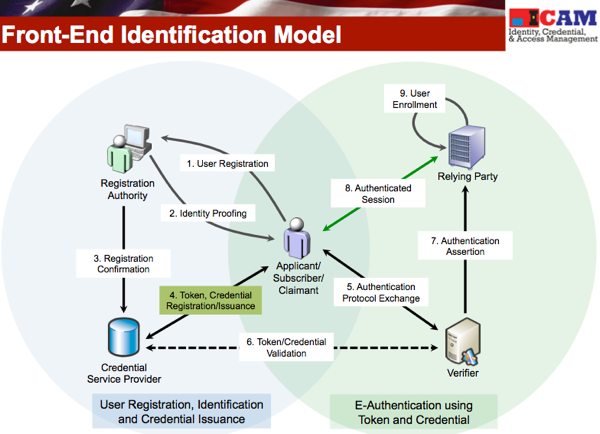
Whenever you start down this path, it is often worthwhile to step back and look at the Registration, Credential Issuance and Maintenance sections of the Electronic Authentication Model (from NIST SP-800-63-1 PDF):

As you can see above, you have an Applicant that registers with a Registration Authority (RA), which identity proofs the Applicant and confirms the results of that event with a Credential Service Provider (CSP). The CSP in turn interacts with the Applicant to issue a Credential that binds the identity of the person to a Token (a secret, or something that holds a secret used in a remote authentication protocol). At this point in time the Applicant becomes a Subscriber of the CSP. The rest of the model focuses on the use of the credential and token.

While the RA and CSP functions, especially in the commercial world, are often done by the same entity, the key point to keep in mind is that Registration, Identity Proofing, Token Creation/Issuance and Credential Issuance are all distinct and logically separate processes that can be broken up into separate physical encounters or online/electronic transactions. Point of fact, they could be broken up and fulfilled by entirely separate entities. The challenge in this, as noted in Mark's blog entry, is to make sure that the same party is acting as the Applicant through the process.

A model to look at and potentially implement [1] that may help in this area is what we use within the US Government for credential issuance  at Level of Assurance (LOA 1 - 4). We have increasingly stringent requirements (as we move from Level 1 to 4) that we need to follow in order to make sure that the same Applicant is moving through the process (More details in NIST 800-63-1):

  • At Level 1: There is no specific requirement, however some effort should be made to uniquely identify and track applications.
  • At Level 2: For electronic transactions, the Applicant shall identify himself/herself in any new transaction (beyond the first transaction or encounter) by presenting a temporary secret which was established during a prior transaction or encounter, or sent to the Applicant’s phone number, email address, or physical address of record.
  • At Level 3: For electronic transactions, the Applicant shall identify himself/herself in each new electronic transaction by presenting a temporary secret which was established during a prior transaction or encounter, or sent to the Applicant’s physical address of record. Permanent secrets shall only be issued to the applicant within a protected session.
  • At Level 4: Only physical transactions apply. 

Ultimately, whatever types of credentials you are issuing, and in whatever modalities that credential is being used, if you cannot have confidence in the processes used to assure that the person using the credential is indeed the person that went through the above steps to get the credential, then you have gained little to no value by choosing to issue a technically "stronger" credential type.

[1] For those reading this from USG Agencies: The choice to implement or not does not exist for us :-). OMB Policy on Annual FISMA Guidance M-11-33 (PDF) makes implementation of NIST Guidance a requirement.

:- by Anil John

Assurance Level Escalation and Government Relying Parties

One of the questions that often comes up in discussions regarding Federation and Authentication Levels of Assurance (LOA) is around how one might raise the assurance level of an authentication session. BTW, NIST seems to have an aversion to using the words "Step-Up Authentication" and uses the term "Assurance Level Escalation" in the Electronic Authentication Guidance (NIST SP-800-63-1) [PDF].

In particular, Assurance Level Escalation is considered a special case of multi-token authentication, where the presentation of the first token and the second token are simply separated in time.

As such it is important to understand the token types that are approved for use with US Government Relying Parties for this purpose:

  • Memorized Secret Token - Something you know
  • Pre-Registered Knowledge Token - Something you know
  • Look-up Secret Token - Something you have
  • Out of Band Token - Something you have
  • Single Factor (SF) One-Time Password (OTP) Device - Something you have
  • Single Factor (SF) Cryptographic Device - Something you have
  • Multi-Factor (MF) Software Cryptographic Token - Something you have; it may be activated by something you know or something you are
  • Multi-Factor (MF) One-Time Password (OTP) Device - Something you have; it may be activated by something you know or something you are
  • Multi-Factor (MF) Cryptographic Device - Something you have; it may be activated by something you know or something you are


The above table (NIST SP-800-63-1, Table 7) describes the highest level of assurance that is possible using a combination of two approved token types. This is a per-session assurance level escalation, and is not something more permanent.

:- by Anil John